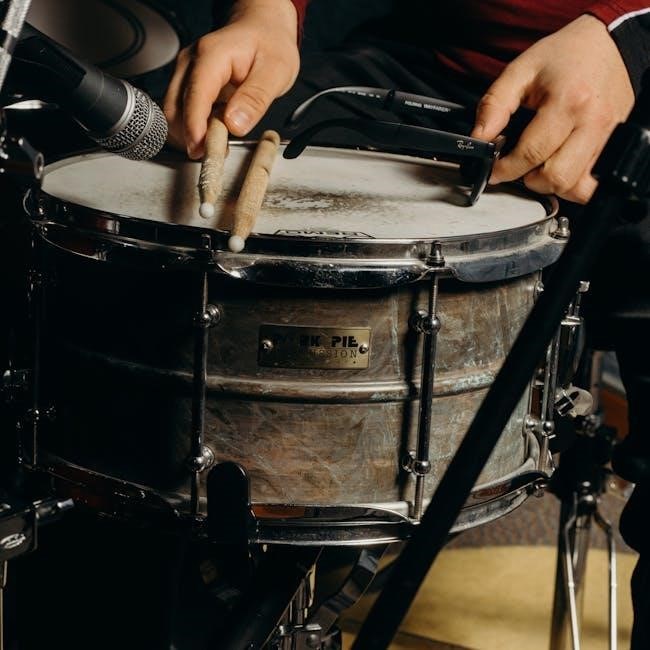
Stick Control for the Snare Drummer: A Comprehensive Plan
George Lawrence Stone’s foundational work, widely available as a PDF, remains a cornerstone for drummers seeking enhanced technique and rhythmic precision.
Historical Context of Stick Control
Stick Control emerged in an era demanding technical proficiency from percussionists, particularly those involved in vaudeville and early orchestral settings. George Lawrence Stone, a seasoned performer and educator, recognized a gap in training materials focused on fundamental control. Prior to its 1938 publication, drummers largely relied on apprenticeship and oral tradition for developing technique.
The book’s arrival coincided with the burgeoning popularity of jazz and swing, genres requiring increasingly complex rhythmic execution. Stone’s approach, emphasizing systematic practice of rudiments and dynamic control, provided a standardized method for achieving this; The availability of Stick Control as a PDF in modern times has broadened its reach, ensuring its continued relevance for generations of drummers. It quickly became, and remains, a vital resource, influencing countless percussionists and solidifying its place in drumming history.

George Lawrence Stone: Biography and Influence
George Lawrence Stone (1886-1967) was a prominent percussionist, educator, and author whose legacy is inextricably linked to Stick Control for the Snare Drummer. Beginning his musical journey at age sixteen as the youngest member of the musicians union, Stone honed his skills as a solo xylophonist on the Keith Circuit, gaining valuable performance experience.
However, his true impact stemmed from his dedication to teaching and his insightful approach to technique. Stick Control, his most celebrated work, reflects his belief in the importance of foundational exercises for developing control, speed, and flexibility. The enduring popularity of the book, readily accessible today as a PDF, demonstrates its lasting influence. Stone’s methods continue to shape drumming pedagogy, and his book remains a cornerstone of technical training for drummers worldwide, cementing his position as a pivotal figure in percussion education.
The Publication History of Stick Control
Stick Control for the Snare Drummer has enjoyed a long and impactful publication history, evolving with accessibility over the decades. Originally released in print, the book quickly became a standard resource for percussionists. Its enduring value led to numerous reprints and editions, solidifying its place in drumming literature.
More recently, the advent of digital technology has broadened its reach significantly. Today, a readily available PDF version of Stick Control is widely circulated and downloaded from platforms like MuseScore.com, offering convenient access for students and professionals alike. This digital format, alongside continued print editions from publishers like Alfred Music, ensures the book remains accessible to a global audience. The book’s consistent availability, in both physical and digital forms, underscores its timeless relevance and continued importance in drumming education.

Understanding the Core Concepts
Stick Control’s exercises, often accessed as a PDF, emphasize rudiments, grip, posture, and dynamic control—building a solid foundation for all drummers.
Rudiments and Their Application
George Lawrence Stone’s Stick Control, frequently found as a downloadable PDF, meticulously breaks down essential rudiments, serving as the bedrock for developing snare drumming proficiency. The book doesn’t simply present the rudiments; it focuses on their systematic application through a progressive series of exercises.
These exercises aren’t merely about speed or volume, but about cultivating control, flexibility, and evenness. The single stroke roll, double stroke roll, paradiddles, and flams—all foundational elements—are explored in depth. The PDF format allows drummers to easily annotate and practice specific patterns.
Stick Control emphasizes applying these rudiments across the entire drum set, not just confining them to the snare. This approach fosters musicality and allows drummers to translate technical skills into creative expression. The book’s enduring popularity, evidenced by its continued availability as a PDF, stems from its practical and universally applicable methodology.
The Importance of Grip and Posture
While often overlooked, George Lawrence Stone’s Stick Control – readily accessible as a PDF – implicitly stresses the crucial role of proper grip and posture. Though not explicitly detailed with diagrams, the exercises themselves demand a relaxed and efficient technique to execute effectively. Attempting the patterns with tension or poor form quickly reveals limitations.
The book’s focus on control necessitates a grip that allows for nuanced dynamics and rebound. A tense grip hinders fluidity and speed, directly contradicting the book’s objectives. Similarly, correct posture—sitting or standing with balanced alignment—is essential for maximizing control and minimizing fatigue.
Many supplemental resources, often found alongside the PDF version, now offer detailed guidance on grip and posture, complementing Stone’s foundational exercises. Mastering these fundamentals unlocks the full potential of the techniques presented within Stick Control.
Dynamic Control and Accentuation
George Lawrence Stone’s Stick Control, frequently studied via PDF downloads, isn’t merely about speed; it’s fundamentally about dynamic control. The exercises, while seemingly simple, provide a framework for developing the ability to play with a wide range of volumes and accents. The core patterns encourage consistent strokes, but the true artistry lies in varying the intensity.
The book implicitly challenges drummers to explore subtle nuances in touch. Accenting specific notes within the patterns—achieved through slight increases in effort—creates rhythmic interest and musicality. This control is built through repetition and mindful practice, focusing on the feeling of the stick’s rebound and the resulting sound.
Numerous online resources accompanying the PDF offer interpretations and exercises specifically designed to enhance dynamic control and accentuation, expanding upon Stone’s original concepts.
Analyzing the Exercises
The Stick Control PDF presents progressive exercises, building from single strokes to complex patterns, demanding focused practice for technical proficiency and rhythmic understanding.
The Single Stroke Roll: Foundation and Variations
Stick Control’s initial exercises heavily emphasize the single stroke roll, establishing a fundamental base for all subsequent techniques. The readily available PDF version allows drummers to meticulously dissect Stone’s approach to building consistent, even strokes at varying tempos.
The book doesn’t simply present the roll; it systematically introduces variations in accentuation and dynamic control. These subtle shifts, clearly notated within the PDF, force the drummer to actively listen and refine their touch. Exercises progress from simple, unaccented rolls to patterns incorporating accents on every beat, then to more complex rhythmic groupings.
This methodical approach, easily accessible through the Stick Control PDF, isn’t merely about speed; it’s about cultivating control and precision. The goal is to achieve a fluid, relaxed motion that allows for effortless execution, regardless of tempo or dynamic level. Mastering these foundational single stroke variations, as outlined in the PDF, unlocks the potential for more advanced rudimental applications.
Double Stroke Roll Techniques
Stick Control progressively introduces double stroke roll techniques, building upon the foundation established by the single stroke exercises, all conveniently available in the widely circulated PDF. Stone’s method emphasizes achieving a consistent bounce, minimizing tension, and maximizing efficiency. The PDF provides a clear visual representation of the exercises, aiding in proper technique development.
The book doesn’t immediately jump into rapid double strokes; instead, it begins with controlled, deliberate movements, focusing on the rebound. Variations within the Stick Control PDF include accented doubles, doubles combined with single strokes, and patterns designed to challenge coordination. These exercises are crucial for developing the necessary muscle memory and control.
Successfully navigating these double stroke exercises, as presented in the PDF, requires diligent practice and a keen awareness of one’s technique. The ultimate aim is to produce a smooth, even sound, demonstrating mastery over the bounce and a relaxed grip.
Paradiddle Variations and Applications
Stick Control’s exploration of paradiddles, readily accessible within the popular PDF version, extends far beyond the basic RLRR LRLL pattern. Stone systematically presents variations, altering accents and rhythmic groupings to challenge the drummer’s coordination and control. The PDF format allows for easy annotation and personalized practice notes.
These variations aren’t merely academic exercises; Stone emphasizes their practical application to musical contexts. The Stick Control PDF demonstrates how paradiddle-based patterns can be incorporated into fills, grooves, and solos, adding rhythmic complexity and interest. Understanding the underlying structure of the paradiddle unlocks a wealth of creative possibilities.
The book’s progressive approach, clearly laid out in the PDF, builds from simple variations to more intricate combinations. Mastering these patterns requires focused practice and a strong understanding of stick control fundamentals. Ultimately, the goal is to internalize the paradiddle and utilize it as a versatile rhythmic tool.
Flam Exercises and Control
Stick Control, conveniently found as a PDF download, dedicates significant attention to flam exercises, crucial for developing nuanced control and precision. Stone’s methodical approach begins with basic flam patterns, gradually increasing in complexity and demanding greater coordination between the hands. The PDF’s clear notation facilitates accurate reading and practice.
These exercises aren’t simply about executing the flam stroke; they’re about controlling the grace note and achieving a consistent, musical sound. The Stick Control PDF illustrates how to manipulate dynamics and accents within flam patterns, adding expressive depth. Developing a relaxed grip and proper technique is paramount.
Stone emphasizes the importance of applying flam concepts to various rhythmic contexts. The PDF implicitly encourages drummers to explore flam taps, drags, and other variations, expanding their rhythmic vocabulary. Consistent practice, guided by the PDF’s exercises, unlocks a refined and versatile flam technique.
Practical Application and Practice Strategies
Utilizing the readily available Stick Control PDF, drummers can translate exercises to the kit, enhancing musicality and coordination through focused, deliberate practice.
Integrating Stick Control into Drum Set Playing
The true power of George Lawrence Stone’s Stick Control, often accessed as a convenient PDF, isn’t solely realized through isolated snare drum practice. Its principles are profoundly transferable to the full drum set, unlocking a new level of control and musical expression. Begin by applying single stroke rolls around the kit – snare, toms, and even cymbals – maintaining consistent dynamics and evenness.
Next, incorporate double stroke rolls and paradiddles, shifting the accents between different drums to develop independence and coordination. Visualize the stick control patterns as they relate to grooves and fills, rather than just technical exercises. For example, a paradiddle can be re-imagined as a fill moving around the toms.
The PDF format allows for easy annotation, marking specific patterns to apply to common drum set rhythms. Focus on maintaining the same level of precision and control on the full kit as you achieve on the snare, gradually increasing tempo and complexity. This integration transforms technical drills into musical building blocks.
Developing a Practice Routine
A structured practice routine centered around George Lawrence Stone’s Stick Control – readily available as a PDF – is crucial for consistent improvement. Begin with a warm-up, focusing on grip and posture, before diving into the exercises. Allocate specific time slots for different rudiments, starting with single strokes and gradually progressing to double strokes, paradiddles, and flams.
Utilize the PDF’s portability to practice anywhere, anytime. Short, focused sessions (15-30 minutes) are often more effective than long, unfocused ones. Record yourself playing to identify areas for improvement. Vary the tempo and dynamics of each exercise, challenging your control and musicality.
Don’t simply play through the book; actively listen to your sound and strive for precision. Incorporate a metronome to develop timing and consistency. Regularly revisit earlier exercises to reinforce fundamental skills. A well-designed routine transforms Stick Control from a book into a powerful tool for growth.
Troubleshooting Common Challenges
When working with George Lawrence Stone’s Stick Control – often accessed as a convenient PDF – several challenges frequently arise. Tension is a common issue; consciously relax your grip and shoulders. Uneven strokes indicate a lack of control; slow down and focus on consistent rebound. Difficulty with speed suggests insufficient foundational technique – revisit earlier exercises.
If you struggle with accents, isolate the accented notes and practice them slowly, gradually increasing tempo. Ensure proper wrist motion, avoiding excessive arm movement. Utilize a mirror to observe your technique and identify areas for correction.
Remember, consistency is key. Don’t be discouraged by plateaus; persistent practice, guided by the PDF’s exercises, will yield results. Break down complex patterns into smaller, manageable segments. Seek guidance from a drum instructor if needed to address persistent difficulties;

Resources and Further Learning
Stick Control, readily available as a PDF, is complemented by numerous online resources and supplemental materials for dedicated drumming practice.
Available Editions and Formats (PDF, Print)
George Lawrence Stone’s Stick Control for the Snare Drummer enjoys widespread availability in multiple formats, catering to diverse learning preferences. Traditionally, the book has been published in print by Alfred Music, offering a tangible experience for musicians who prefer physical copies. However, the digital age has brought forth convenient PDF versions, easily downloadable from platforms like MuseScore.com, providing instant access to the exercises.

These PDF editions are particularly popular due to their portability and affordability. Musicians can access the material on various devices – tablets, laptops, or smartphones – facilitating practice anywhere, anytime. Furthermore, numerous online retailers offer both print and digital versions, ensuring accessibility for a global audience. The book’s enduring popularity has led to various reprints and editions over the years, though the core content remains consistent. Finding a legitimate PDF source is crucial to ensure quality and accuracy of the exercises.
Online Resources and Supplemental Materials
Beyond the core Stick Control book, a wealth of online resources complements the learning experience. Numerous drumming websites and forums host discussions, analyses, and practice tips related to the exercises. YouTube channels dedicated to drumming often feature tutorials demonstrating proper technique and applications of the rudiments found within the book. Many instructors utilize the PDF version as a central component of their lessons, supplementing it with personalized guidance.
Websites like MuseScore.com not only offer the PDF for download but also foster a community where drummers share their interpretations and variations. Supplemental materials, such as play-along tracks and metronome exercises, are readily available online, aiding in timing and consistency. Exploring these resources can significantly enhance understanding and accelerate progress. Accessing these materials alongside the PDF version provides a dynamic and interactive learning environment, catering to different learning styles.
Related Drumming Books and Materials
Expanding beyond Stick Control, several complementary resources bolster a drummer’s technical foundation. George Lawrence Stone’s other works, like those focusing on bass drum control (Colin Bailey’s book is a notable example), offer specialized training. Rudiment-focused books, detailing variations and applications, build upon the core concepts introduced in Stick Control. Many drummers also benefit from exploring materials covering grip techniques and ergonomic considerations.
The PDF format of Stick Control facilitates easy integration with other digital resources. Books like Kevin Tuck’s “Drum Book” provide broader rhythmic studies. Modern Drummer magazine’s historical recognition of Stick Control highlights its enduring relevance alongside contemporary drumming literature. Exploring these related materials, alongside consistent practice with the PDF, creates a well-rounded approach to drumming education, fostering both technical proficiency and musicality.

Advanced Techniques and Extensions
Mastering Stick Control’s exercises, often practiced via PDF, unlocks complex rhythms and expands application to diverse percussion instruments, enhancing overall musicality.
Beyond the Basics: Exploring Complex Rhythms

Once the fundamental exercises from Stick Control – readily accessible as a PDF – are internalized, drummers can venture into crafting intricate rhythmic patterns. This involves strategically combining rudiments, not just executing them in isolation. Consider superimposing different rhythmic groupings over a consistent pulse, utilizing the control gained from Stone’s method;
For example, applying paradiddle variations at increasing tempos, or layering flams with single strokes, builds both dexterity and creative rhythmic vocabulary. The PDF format allows for annotation, enabling personalized exercise creation. Experiment with odd-time signatures, challenging your internal clock and pushing the boundaries of your rhythmic feel.
Furthermore, explore polyrhythms – playing two or more conflicting rhythms simultaneously – to develop independence and a deeper understanding of rhythmic interplay. Stick Control provides the foundational control necessary to navigate these complexities, transforming basic exercises into a springboard for advanced rhythmic exploration and improvisation.
Applying Stick Control to Other Percussion Instruments
The principles established in Stick Control, often studied via PDF versions, transcend the snare drum, proving invaluable across the percussive landscape. The core concepts of grip, stroke control, and dynamic variation are universally applicable. Applying these to instruments like the marimba, xylophone, or even timpani fosters consistency and precision.
Adapting exercises from the PDF to different mallets or beaters requires nuanced adjustments, but the underlying muscle memory and control remain crucial. For example, the single stroke roll, mastered on the snare, translates directly to smoother, more even mallet work.
Furthermore, the book’s emphasis on independence aids in multi-percussion setups, allowing for coordinated and articulate playing across various instruments. Ultimately, Stick Control isn’t just about snare drumming; it’s about developing a holistic percussive technique applicable to any instrument within your reach.
The Role of Stick Control in Musicality
While often perceived as a purely technical exercise, studying Stick Control – readily available as a PDF – profoundly impacts musicality. The book’s focus on dynamic control and accentuation isn’t merely about volume; it’s about shaping phrases and conveying emotion. Mastering these nuances allows drummers to move beyond mechanical precision and inject personality into their playing.
Consistent practice with the PDF’s exercises cultivates a heightened sensitivity to rhythm and timing, enabling more expressive interpretations. The ability to execute subtle variations in stroke weight and placement translates to more nuanced and engaging grooves.
Ultimately, Stick Control provides the foundational technique necessary to translate musical ideas into reality, fostering a deeper connection between the drummer and the music itself. It’s a tool for unlocking artistic potential, not just technical proficiency.